


 Posts
Posts


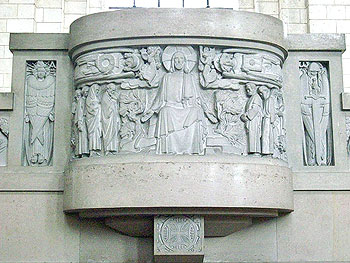 Perhaps you should be paying more attention to the Mass itself, but your distraction by no means shifts your attention away from God. On the contrary, the cathedral is designed for such a situation. Everywhere you look some form of art has been integrated with the architecture to tell the story of the Christian faith.
 Whether stone carvings, colorful mosaics, stained glass, painted murals, or intricately carved wood, the entire room is filled with art that tells the stories of the Bible and the beginning of Christian faith. The very shape of the room (most likely a cross shape) is meant as a reminder, a symbol of the faith.
 Imagine that it is primarily through these images that you understand your faith and can teach it to your own children.
Fast forward to today. Most protestant worship services are based on the use of words. That is, we do an awful lot of reading and speaking. We often use words that younger generations do not understand. We tend to assume literacy and knowledge of traditionally memorized things like The Lord’s Prayer, or The Apostle’s Creed. Even music, in the form of hymns or songs, is oriented toward the use of words. And the style of music is often foreign to young people who were not raised in the church.
You may have heard or noticed that younger generations are visually oriented. Even television ads that are geared toward the “30 and under” crowd rely much more on fast paced visuals than the spoken word. When there are words, they are flashed individually, or spoken in brief phrases. When attending games for professional sports, there are often screens in the stadium that show closeups of the live action, as well as replays.
Just as the Medieval cathedrals were filled with the multimedia of the time, we have our own multimedia tools to use during worship in order to best reach and teach the rising generations. With today’s technology, we no longer have to choose a particular piece or style of art that will remain for decades or centuries. The ability to project images onto screens or walls heightens our ability to develop multimedia presentations that are directly relevant to the theme of each particular worship service. When we capitalize on this ability, we help many people to stay engaged in worship, even if their attention has drifted from a song, prayer, or spoken message.
The use of multimedia technology goes far beyond the worship service. Computer games and the internet are being used in schools to help kids learn. In our own Youth Center we have computers with programs that help our children and youth to learn Bible stories and principles. I have previously written about the video projects our youth have been working on.
During his weekend with us in April, our consultant, Bill Tenney-Brittain, emphasized a need to make more use of multimedia in order to better reach the younger generations. Here at First Presbyterian Church, we are well on our way to doing this. In the coming months, we will be looking at and trying out ways that we can improve on what we are already doing.
On a personal level, as a member of the “30 and under” crowd, I am overjoyed by the recommendation to work on improving what we’re already doing, and I’m more than excited to see the fruit of that labor. I’m looking forward to seeing members of our congregation using their talents, skills and passion, to further develop our use of multimedia, whether in worship, on the internet, or other aspects of our ministry.
May the Spirit stir in your hearts and minds,
Anna Parkinson


